The On It Studio
How Many Units Should I Order for a First Print Run?
The printer's quote is in, the minimum is 1,000, and you're about to type that number into the order form because it's the smallest one on offer. Before you do, work out how many units to order for a first print run from the cash you can tie up and the sales you can make before your next deadline. We'll build a one-page quantity ladder together from two or three supplier quotes and a spreadsheet you already have. Sending the quote requests takes an afternoon, and the replies come back on the suppliers' schedule.
Should the factory's minimum decide how many units you order first?
No. The minimum is the smallest run the factory will quote you, and it doesn't know how many you can sell. Put dollars on the gap and the difference gets obvious fast.
Assume a landed cost of $5 a unit and a minimum of 1,000 (swap in your own quote). That's $5,000 out the door before the first sale. If your first term sells 300, then 700 units sit in a box with your cash inside them.
Kids education and wellness products add two pressures to that box. A first run often carries a date (a term start, a conference) and a shelf life (a revised lesson plan, a label correction). Our kids and education resources cover more of that kind of launch, and the rest of our founder ops posts sit alongside them.
The creative part of a kids product is short and the admin around it is long. We'd run each product as a checklist with owners and dates, and settle costing and delivery dates first. The quantity comes last, once you know what each row costs and when it lands.
What does the minimum leave out?
Landed cost is the unit price plus freight, duty and handling to your warehouse. The factory quote covers the unit price. You pay the rest.
Here's the part nobody tells you: the unit price you're comparing across quotes leaves out everything it takes to get the box to your door, and a cheaper factory with pricier freight can cost more by the time the box arrives. We have no sourced figure for how big a slice those extras take on print orders, so get each one quoted in writing instead of guessing a percentage.
Prices have been moving, too. Three cost-pressure readings show it, and none of them measures print or children's products:
- The Kansas City Fed's write-up of the 2025 Small Business Credit Survey (published August 26, 2026) says tariff-related cost challenges "were most prevalent in the retail (69%) and manufacturing (62%) industries".
- A Minneapolis Fed survey of Ninth District firms, run July 13 to July 31, 2026, found that over 70 percent of survey takers reported wholesale prices up by more than 5 percent over the year. It covers survey takers in that district only.
- The Bureau of Labor Statistics' preliminary second-quarter 2026 release (published August 6, 2026) says manufacturing unit labor costs "increased 3.5 percent from the same quarter a year ago".
For your order, that means a quote from a few months back may not hold. Ask each supplier how long its price is good for.
Example one: a card deck with a thousand-unit minimum
The numbers in both examples are assumptions for illustration. Say the factory's minimum is 1,000 decks at $4.20 each, plus $0.80 a deck to land them in your warehouse. That's $5.00 landed and $5,000 out. You sell at an assumed $15 and expect about 300 sales in the first term.
Those 300 sales bring in $4,500. You're still $500 short of the print bill, with 700 decks in storage. At 300 a term, the box takes just over three terms to clear.
Now say a second supplier quotes 500 decks at $5.40, plus $1.10 in extras: $6.50 landed, $3,250 out. Each deck costs you $1.50 more, so your margin per deck drops from $10 to $8.50. The first term's $4,500 covers the whole bill, though, and you keep $1,750 of cash ($5,000 minus $3,250) for the next product.
The big run has a real upside. If all 1,000 sell, it earns $10,000 in margin against $4,250 for the 500 (before storage and anything else). You'd need more than three terms to get there at this pace, and the content has to stay current until the last deck ships. For a fuller deck-costing walk-through, see how to print your own card game, with cost per deck.
Example two: a school launch date that sets the quantity
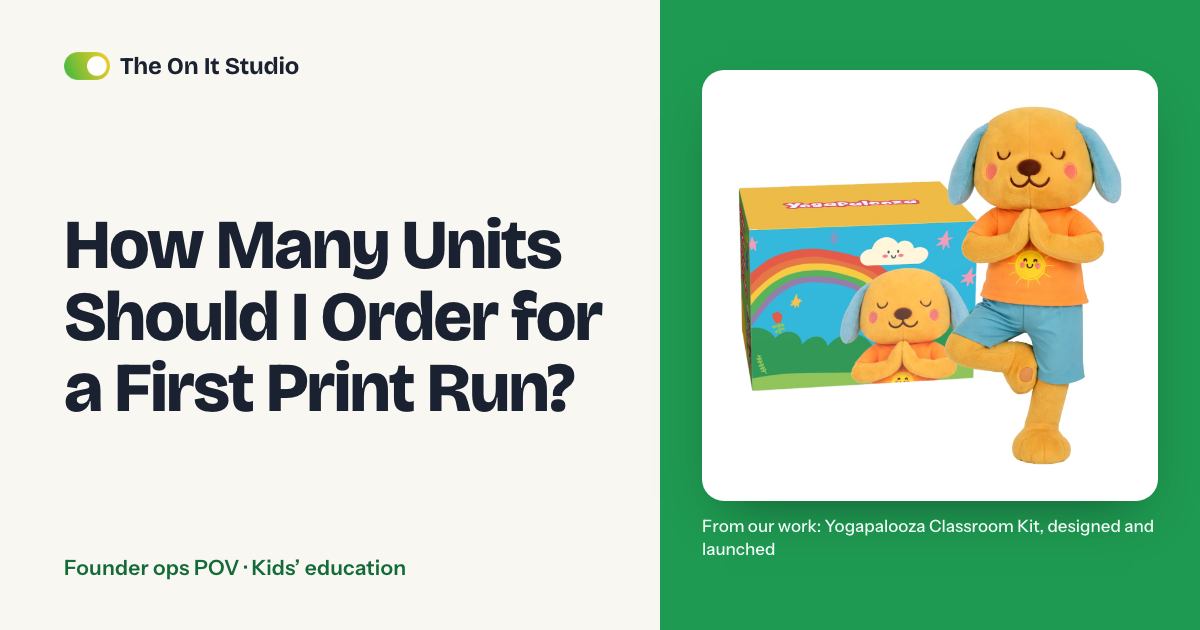
A classroom kit has to be in schools for a term start, ten weeks from the day you'd place the order.
- Quote A: 1,000 kits at $9.00 landed, $9,000 out, landing at 11 weeks (production plus slower freight).
- Quote B: 400 kits at $11.50 landed, $4,600 out, landing at 6 weeks (a faster route).
Quote A saves $2.50 a kit and misses the date by a week. Quote B costs $1,000 more across 400 kits (400 times $2.50) and lands four weeks before term starts, enough time to check the kits and get them to classrooms.
If you've promised schools 400 kits for that term start, a kit that turns up in week 11 is a kit you can't deliver. If you haven't promised anything, the extra $1,000 buys you little, and we'd take Quote A.
A trade-show booth runs on the same math: your print and shipping deadlines set what the booth can be. Our first-time exhibitor's Toy Fair decision log shows how those dates stack up. For a per-unit view of a kit box at two quantities, there's a classroom kit box cost per unit at 500 vs 1,000.
But a bigger run is cheaper per unit. Isn't that the whole point?
Fair objection. If your quote shows a price break at higher quantities, the per-unit saving is real, and a reorder costs you time plus another round of freight. We have no source on how steep price breaks run, so read your own quotes.
That saving only counts on units you sell. Set it against the cash you'd tie up ($5,000 against $3,250 in the deck example) and the chance your content changes (a revised curriculum, a label fix) while the boxes sit in storage. The bigger run wins when the gap on your quote is large, demand is proven (pre-orders or school commitments) and the product won't change soon. If the ladder lands on the bigger run, order it.
What do I do this week?
You'll need a few emails and one spreadsheet. Step 2 is where the ladder usually goes wrong, since a quote that stops at the port looks cheaper than one delivered to your door.
Step 1: Request the same spec at three quantities
- Write one spec covering size, components or page count, materials, finish and packaging. Quotes only compare when the specs match. If you haven't set a target price yet, start with how to cost a product before ordering samples.
- Email two or three suppliers for unit prices at their minimum, a middle quantity and a larger one.
- Ask how long each price holds.
- Check: you have one quote per supplier, all against the same spec, each with three quantity rows.
Step 2: Get delivered costs and a timeline to your warehouse
Spend the most time here. A unit price is easy to get, and the delivered number is the one that decides the ladder.
- Request delivered pricing to your warehouse address, or get a freight forwarder's quote.
- Find out who pays duty and customs, and whether delivery stops at a port or at your door.
- Get the timeline from approved proof to your warehouse for each quantity. A smaller run can ship by a different route than a larger one, so don't assume one timeline fits every row.
- Check: each quantity has an all-in landed number and an arrival date.
Step 3: Fill in the quantity ladder
Make a sheet with these columns and one row per quantity:
| Quantity | Unit cost | Freight, duty, handling | Landed cost per unit | Cash out | Months to clear (your estimate) | Timeline to warehouse | Lands before deadline? |
|---|---|---|---|---|---|---|---|
| Factory minimum | |||||||
| A middle quantity | |||||||
| A larger quantity |
- Landed cost per unit: unit cost plus total freight, duty and handling divided by the quantity.
- Cash out: landed cost per unit times quantity.
- Months to clear: quantity divided by the monthly sales you expect (use the low end of your guess).
- Check: no blank cells.
Step 4: Pick the quantity you can sell through before the next deadline
Run each row through five checks:
- Landed cost per unit at that quantity.
- Cash you can tie up.
- Realistic sales before the next deadline (a term start, a conference).
- Risk the content or label changes.
- Reorder lead time.
Choose the largest row that passes all five. If only the minimum passes, order the minimum; the check cost you an afternoon.
- Check: for the row you picked, you can name the deadline it beats and the cash it leaves you.
Send the step 1 email today, with one spec at three quantities, to each supplier on your list. It's an afternoon of work, and once the quotes are back the ladder tells you whether the minimum is the right number or only the smallest one on offer.
The On It Studio is an operations and automation studio. For children's education and wellness brands we write a costed spec for your product, a 2-week async PDF that prices your unit costs at your quantities and adds landed cost and the timeline to your warehouse; if you'd rather start with your own week, send it through our free ops audit.
Frequently asked questions
How many units should I order for my first print run?
Pick the largest quantity that passes five checks: landed cost per unit, cash you can tie up, realistic sales before your next deadline, the risk your content or label changes, and reorder lead time. The factory's minimum is where the ladder starts, not where it ends.
What is landed cost and how do I calculate it?
Landed cost is the unit price plus freight, duty and handling to your warehouse. Add those three to the quoted total, divide by the number of units, and add the result to the unit price to get landed cost per unit.
What is a minimum order quantity (MOQ) and can I negotiate it?
An MOQ is the smallest run a supplier will produce for a quoted price. Ask each supplier to quote the same spec at the minimum and at higher quantities; the quotes will show whether a lower quantity is available and what it does to the unit price.
Is it better to order more units to get a lower price per unit?
If your quote shows a price break, the per-unit saving is real, but it only pays off on units you sell. Weigh it against cash tied up, storage and the chance that a label or lesson plan changes before the box is empty.
How long does it take to print and ship a product to my warehouse?
That depends on the supplier, the route and the quantity, so ask each one for the timeline from approved proof to your warehouse door at every quantity you're considering. Work backward from your deadline to see which rows of your quantity ladder still make it.