The On It Studio
Classroom Kit Box Cost Per Unit: 500 vs 1,000 Units
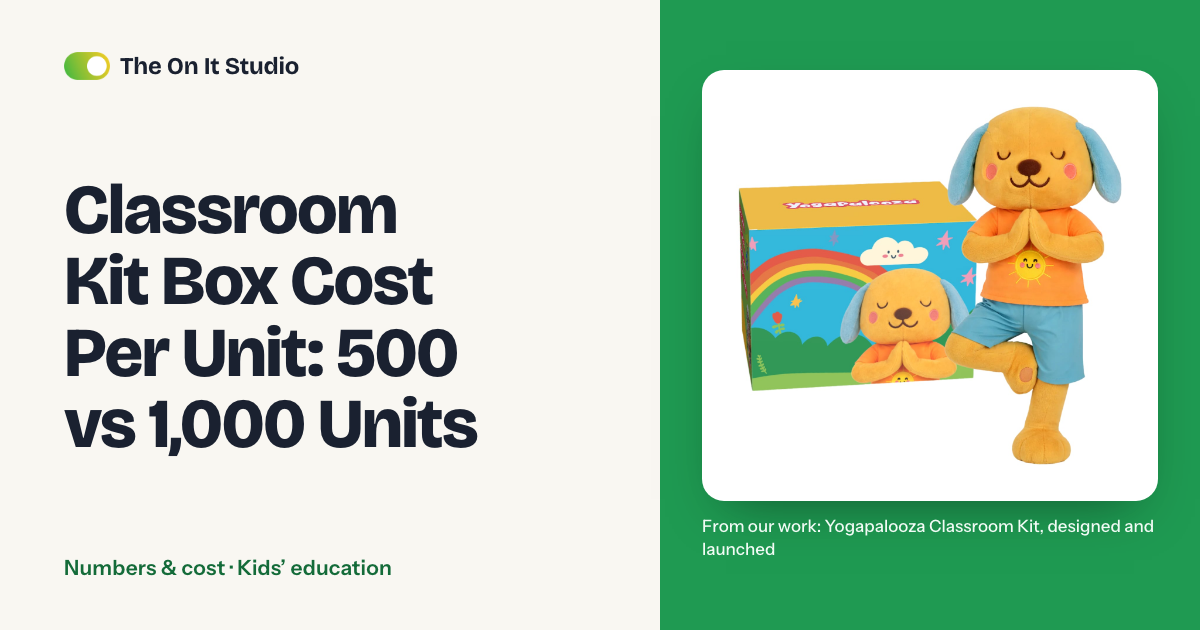
A school buyer wants a quote for classroom kits, and your printer has asked what sounds like a simple question: 500 or 1,000? We'll work out the classroom kit box cost per unit at both quantities, line by line, for a box that holds a printed card deck, a booklet and a tray insert. You'll need an afternoon and two printer quotes to swap our placeholder numbers for yours.
What does a classroom kit box cost per unit at 500 vs 1,000?
On our assumptions, a kit lands at roughly $8 to $12 per unit at 500 and about $6 to $9 at 1,000. They're estimates built from the inputs in the next section, and they'll move once your supplier quotes come in.
The unit price isn't the number that decides this. The cash you commit before the first school order is, and doubling the run pushes the two in opposite directions. Per-kit cost falls about 25 to 27 percent when you go from 500 to 1,000, while total cash out rises about 46 to 50 percent: roughly $4,060 to $6,200 for 500 kits and $5,920 to $9,300 for 1,000.
The kit we're costing and the assumptions behind every number
Each figure below is our working assumption:
- Contents: a 40-card deck, a 16-page booklet and a die-cut tray insert, in a box printed in one color.
- Packing: 25 kits per shipping carton.
- Freight: $18 to $30 per carton.
- Tooling: a one-off die cost of $300 to $600 for the tray.
- Assembly: $0.60 to $1.00 per kit, packed by hand.
Your own spec and shipping route will move all of these, so we've kept the arithmetic on the page. Change one input and you'll see which totals follow it.
Before you ask anyone for a quote, write the kit up as a checklist: one row per part (deck, booklet, tray, box, carton), with an owner and a due date on each. The admin around a kit usually outlasts the design work, and the checklist keeps that admin in one place. Our guide to costing a product before you order samples covers the target-price side of the same job.
Which lines drop when you double the run?
Printing and box costs fall per kit, and tooling gets spread thinner. We assume each print job carries a fixed setup, so a bigger run divides that setup over more kits. The two flat lines stay in the table so the totals are complete.
| Line (per kit, ESTIMATE) | 500 units | 1,000 units | What happens |
|---|---|---|---|
| Card deck | $2.20-$3.20 | $1.50-$2.30 | Falls with quantity |
| Booklet | $1.60-$2.40 | $1.00-$1.60 | Falls with quantity |
| Box and tray insert (ex-tooling) | $2.40-$3.40 | $1.80-$2.60 | Falls with quantity |
| Tooling, amortized | $0.60-$1.20 | $0.30-$0.60 | Spread thinner |
| Assembly | $0.60-$1.00 | $0.60-$1.00 | Flat |
| Freight per kit | $0.72-$1.20 | $0.72-$1.20 | Flat |
| Total per kit | $8.12-$12.40 | $5.92-$9.30 | |
| Total cash | $4,060-$6,200 | $5,920-$9,300 |
You pay for the tray die once, so its per-kit share depends only on how many kits you divide it across:
- $300 / 500 = $0.60
- $600 / 500 = $1.20
- $300 / 1,000 = $0.30
- $600 / 1,000 = $0.60
The totals add up like this, low ends together and high ends together:
- 500 units, low: 2.20 + 1.60 + 2.40 + 0.60 + 0.60 + 0.72 = $8.12
- 500 units, high: 3.20 + 2.40 + 3.40 + 1.20 + 1.00 + 1.20 = $12.40
- 1,000 units, low: 1.50 + 1.00 + 1.80 + 0.30 + 0.60 + 0.72 = $5.92
- 1,000 units, high: 2.30 + 1.60 + 2.60 + 0.60 + 1.00 + 1.20 = $9.30
Lows added to lows give the best case, and highs added to highs give the worst. Expect your quotes to land between the two; they'll show you which end you're nearer.
Which lines don't drop: freight and assembly?
Here's the part nobody tells you: freight per kit stays the same when you double the run. Your carrier charges per carton, and 25 kits fill a carton whether you ordered 500 or 1,000, so 500 kits ship in 20 cartons and 1,000 ship in 40.
- 500 kits: 20 cartons at $18 to $30 is $360 to $600, which is $0.72 to $1.20 per kit.
- 1,000 kits: 40 cartons at $18 to $30 is $720 to $1,200, which is the same $0.72 to $1.20 per kit.
Hand assembly behaves the same way. At $0.60 to $1.00 per kit, packing 500 kits costs $300 to $500 and packing 1,000 costs $600 to $1,000. Unless your packer quotes a volume break (we haven't assumed one), the per-kit figure stays put.
Together these two lines add $1.32 to $2.20 to each kit at either quantity. That's about 16 to 18 percent of the per-kit total at 500 units and about 22 to 24 percent at 1,000. As the run grows, the flat lines take a bigger slice, so each further doubling saves you less than this one.
Unit price vs cash out: what do the extra 500 kits cost?
The extra 500 kits cost about $1,860 to $3,100 more in cash. That's $4,060 to $6,200 for the first run against $5,920 to $9,300 for the larger one, a 46 to 50 percent rise for double the units. Spread over the second 500 alone, the extra cash comes to about $3.72 to $6.20 per kit.
You get a lower unit price and a bigger bill at the same time. Before you take the lower price, run two tests:
- Say you price the kit at $20 (a figure we picked for the math). Before fees, duty and returns, your margin per kit is $7.60 to $11.88 at 500 units and $10.70 to $14.08 at 1,000. That extra margin only counts on kits that sell.
- Say 600 of the 1,000 sell this school year. The other 400 are $2,368 to $3,720 of stock at cost (400 × $5.92 and 400 × $9.30), waiting in storage for next term's orders.
We'd order 1,000 only when school terms and parent orders already give you a clear read on that many. If you're guessing, 500 is cheaper insurance. A first run also shows you what a teacher changes after opening the box, and that change is far easier to make across 500 kits than across 1,000.
What does this estimate leave out: duty, tariffs and landed cost?
The table stops at freight. Duty and tariffs come on top of it, and so do samples and warehouse receiving, before a kit reaches your shelf. We won't guess at duty rates or transit times, because both depend on where your kit gets made and how it gets classified.
Tariff cost pressure is real enough to give landed cost its own line in your sheet. In the 2025 Small Business Credit Survey, tariff-related cost challenges were most prevalent in the retail (69%) and manufacturing (62%) industries, as reported by the Kansas City Fed in August 2026. That survey doesn't cover kit boxes or duty rates, so take it as your cue to ask each supplier about duty before you set a price. A Minneapolis Fed survey of 905 firms in its Ninth District found over 70 percent of respondents reporting wholesale prices up by more than 5 percent over the year. It's a convenience sample, so read it with caution too.
How do I swap in my own quotes?
Four steps turn our placeholders into your numbers. Put most of your effort into Step 2: printers quote in different formats, and you need both quantities side by side.
Step 1: build the sheet
- Open a new Google Sheet with one row per cost line and one column per quantity
- Paste in the per-kit ranges from the table above as placeholders
- Add a SUMPRODUCT formula (it sums the products of corresponding entries in two equally sized ranges) to multiply each per-kit cost by its quantity and total the cash out in one cell
- Test it with our low-end numbers: the 500 column should total $4,060
Step 2: get both quantities from each printer
- Email each printer for a quote on the deck, booklet and box at both 500 and 1,000, in the same email (this cost-per-deck breakdown shows what to ask for if you're pricing the deck separately)
- In that email, ask whether tooling is a separate line or folded into the unit price
- Check each reply: two quantity columns, with tooling on its own line
Step 3: price freight per carton
- Confirm carton count and carton weight for your finished kit
- Ask your carrier for freight priced per carton
- Test it: cartons × price per carton ÷ kits should match the freight line in your sheet
Step 4: fill the landed-cost gaps
- Ask for the country of origin and which duty applies
- Find out what each round of samples costs
- Test it: no row in your sheet should still hold one of our placeholder numbers
More cost breakdowns live in our numbers and cost guides, and there's a shelf of guides for children's education and wellness brands if your next question is about a different part of the launch.
Send the two-quantity quote request first. It's an afternoon to write and send, and the two columns that come back show you how much of your saving comes from printing and how much from tooling.
The On It Studio is an operations and automation studio, and we wrote this post for children's education and wellness brands that sell to schools and parents. If you'd rather have duty and landed cost filled in than guessed, the costed spec is a 2-week async PDF that prices your kit at your quantities and carries it through landed cost to a timeline for reaching your warehouse; if you want the admin around a launch handled, see our ops and AI automation retainer, or send us your week through the free ops audit.
Frequently asked questions
How much does it cost to make a classroom kit?
On our assumptions (a 40-card deck, a 16-page booklet, a die-cut tray insert, 25 kits per carton), a kit lands at roughly $8 to $12 at 500 units and $6 to $9 at 1,000. These are estimates, not supplier quotes, so get quotes for your own spec.
Why is the cost per unit lower at higher quantities?
We assume each print job and each tool carries a fixed cost, so a bigger run spreads it over more kits. In our worked example, tooling of $300 to $600 is $0.60 to $1.20 per kit at 500 units and $0.30 to $0.60 at 1,000.
Does freight get cheaper per kit when I order more?
Not on our assumptions. If freight is charged per carton at $18 to $30 and 25 kits fit in a carton, it's $0.72 to $1.20 per kit at both 500 and 1,000 units. Ask your carrier whether any volume break exists.
What is landed cost and what does it include?
Landed cost is what a kit costs by the time it reaches your warehouse. Our table stops at freight, so it leaves out duty, tariffs, samples and warehouse receiving, which depend on where the kit is made and how it's classified.